Can environmental protections be simplified without weakening environmental rights? The EU is presenting its forthcoming Environmental Omnibus package as a way to boost competitiveness and cut red tape. But speeding up project approvals could come at the expense of public participation and access to justice, while undermining environmental safeguards. For young people, the debate is ultimately about who gets to shape Europe’s environmental future.
The Environmental Omnibus package is set to include proposals to fast-track environmental permitting and expand the range of projects considered “strategic”. These deregulation measures are presented as administrative simplification, but they also weaken existing safeguards and reduce opportunities for public oversight. At stake is whether environmental rights can be protected in the face of growing corporate pressure.
Environmental assessments are not red tape
Environmental Impact Assessments (EIAs) play a critical role in ensuring that public authorities understand the potential consequences of incoming projects before a decision is made. They help identify risks to biodiversity, climate, ecosystems, and human health. They are also a key opportunity for public participation.
The European Union now proposes to accelerate its timeline. This creates a key risk: reducing the quality of these evaluations. Faster procedures do not make environmental harms disappear; they make them harder to identify and prevent.
This strategy also hides the real bottleneck behind long procedures, which is often the lack of resources and staffing within public authorities in charge of EIAs. The current proposal should not come as a substitute for adequately funding the relevant institutions.
A dangerous expansion of “strategic projects”
Another concerning element currently under discussion is the creation of a broad category of “strategic projects” or “strategic sectors”. Projects falling under this category could be automatically presumed to “serve the public interest” and benefit from a fast-tracked permitting procedure. If adopted, there are only a few guarantees that such projects would then need to meet sustainability or decarbonisation criteria to be approved.
Importantly, some Member States have advocated for an extensive list of eligible sectors, including ports, airports, factories, data centres, AI infrastructure, and military mobility projects, which would de facto dilute the exceptional nature of the mechanism and make it quite mainstream.
Access to justice under threat
Discussions at both the Commission and Member State levels have explored introducing new procedural rules. Under these proposals, communities and civil society organisations would not be able to raise legal arguments in court if they failed to present them during the earlier permitting process.
This is an issue because, in many cases, environmental impacts only become visible late in the process. Restricting the ability to raise new arguments during judicial review could make it harder for affected communities and NGOs to challenge permits.
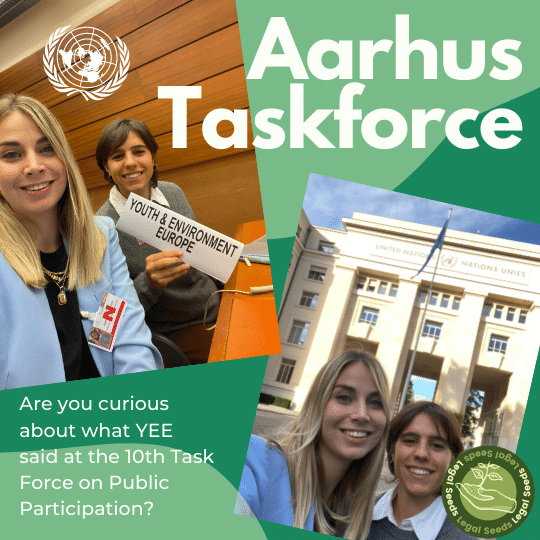
These proposals also conflict with the Aarhus Convention, an international treaty ratified by both the EU and its Member States, which guarantees access to justice as a core environmental right. Courts and compliance bodies have consistently interpreted the rights from the Convention as requiring broad and effective access to judicial review in environmental matters.
Civil society is mobilising
A broad coalition of environmental organisations of which Youth and Environment Europe (YEE) is part, and including the European Environmental Bureau (EEB), BirdLife Europe, WWF, and ClientEarth, has warned against the latest deregulation developments. The campaign Hands Off Nature is calling on decision-makers to reject proposals that undermine environmental law and public participation.
Europe needs faster solutions to the climate and biodiversity crises, but not at the cost of public participation and access to justice.
Young people will live the longest with the consequences of today’s decisions. Yet proposals that weaken environmental scrutiny reduce the ability of future generations to influence decisions that will shape their future.
To learn more about the EU Omnibus Simplification Package, read our report on the topic: Understanding the EU Omnibus Simplification Packages | YEE
To engage with the campaign, you can visit the website: https://handsoffnature.eu/






 YEE aims to unite environmental youth non-profit organisations in Europe in order to enhance international cooperation, increase knowledge about the climate crisis, raise awareness of environmental problems and to strengthen participation of youth in environmental decision-making.