
Summary
What are NRPs?
National Restoration Plans (NRPs) explain how each EU country will implement the Nature Restoration Law and how it achieves its targets for 2030, 2040, and 2050!
What is the problem?
- The proposed format fails to recognise youth participation.
- It does not offer countries the space to connect nature restoration with intergenerational equity.
What are our recommendations?
Youth Participation
- Add a “Youth Participation” section
- Ensure youth voices are documented
- Promote youth-led initiatives
Youth Contributions to Restoration Targets
- Recognise youth-led restoration projects
- Ensure youth have resources to contribute effectively
Intergenerational Equity
- New section: “Consideration of Future Generations”
- Make intergenerational equity a required principle in decision-making
Environmentally Harmful Subsidies
- Public funds shouldn’t support activities that harm biodiversity
- Concrete plans to phase out harmful subsidies
- Alignment with EU biodiversity commitment
The European Commission’s proposed uniform format for National Restoration Plans (NRPs) represents a thoughtful and comprehensive framework to support member states (MS) in achieving the ambitious targets set by the Nature Restoration Law (NRL). Nevertheless, reference to a core aspect that is key to the success of this Regulation is missing: youth. This omission is particularly significant, as young people will inherit the long-term consequences of environmental policies and have a crucial role to play in driving innovation, advocacy, and community engagement for successful restoration efforts. We therefore highly recommend the inclusion of the following:
Recognition of Youth Input in the Participation Process for NRPs
We propose adding a distinct priority under section 2.1, titled “Youth Participation,” within the “Public Participation” section. Young people’s lack of participation in environmental decision-making has been evident in the creation of National Energy and Climate Plans (NECPs). However, the NRL, and in particular, the NRPs, offer a valuable opportunity to address this gap by ensuring clear and dedicated participation pathways for young people within the NRL framework.
Following this, and for the purposes of Article 15(3(w)), we recommend more specificities to be added under Public Participation, such as subsections categorising the involvement of different stakeholders and the inputs they put forward. This way, the NRPs could provide a detailed explanation of the views expressed per category of stakeholder. We further recommend the addition of a section detailing the participation methods that the states followed (such as public consultations, multi-stakeholder group meetings, deliberations, etc…) and a short summary of each.
Youth Contributions to Restoration Targets
In addition to youth involvement in public consultations, we recommend that the NRP format include specific sections that highlight youth contributions to project implementation, citizen science, and advocacy efforts for restoration. For example, we suggest adding a new point (e.g., 14.5.5) to the format: “Describe the role of young people in the implementation of this measure.” This inclusion would support the alignment of restoration activities with national environmental citizen service programs or youth environmental corps, ensuring that young people are actively contributing to these important efforts.
Intergenerational Equity
We propose requiring MS to explicitly document how their plans address the rights of future generations. Intergenerational solidarity is recognised as a fundamental principle within the Treaty on European Union (TEU) and the Charter of Fundamental Rights. To incorporate this in NRPs and contribute to intergenerational equity, we suggest the following:
- Section 4.1.4: Include “intergenerational equity” as an example under “Other potential co-benefits.” Additionally, we support making this section mandatory instead of optional.
- Section 2.4: Introduce a new section titled “Consideration of Future Generations” to emphasize the importance of long-term planning.
- Section 14.3.4: Add a new section titled “Intergenerational Benefits” to highlight the advantages of prioritizing sustainability for future generations.
Environmentally Harmful Subsidies
In addition to Section 4.3.2, which gives an indication of the harmful subsidies that may negatively impact the achievement of the goals set under the regulation, we would like MS to explicitly include what actions are being taken to phase out the subsidies in question. We recommend expanding the section to include Subsection 4.3.2.1 titled “Actions taken to phase out environmentally harmful subsidies not in line with meeting the goals of the regulation”. In a parenthesis, examples can be included, such as “…(e.g. market-based instruments and green budgeting and financing tools)”. A reference to the supportive actions a state takes to phase out the specific subsidies, in line with the NRL Article 15(3(v)), would also be a useful addition to the format. This would also contribute to fulfilling Decision (EU) 2022/591 Art 3(2(h)), according to which MS “shall identify other environmentally harmful subsidies and report them regularly to the Commission”. Incorporation of more information about environmentally harmful subsidies in the NRL would therefore have multiple positive effects. In support of the latter, we would also like to draw attention to Recommendation 9 of a joint CSO statement on the EU budget for biodiversity, which calls for the harmonisation of the identification of environmentally harmful subsidies, and of a reporting mechanism. Lastly, we would like to draw attention to point 3.2 of NAT/926 of the EESC’s own initiative opinion titled “A comprehensive strategy for biodiversity at COP16”, which highlights the urgency of phasing out environmentally harmful subsidies for the purposes of biodiversity governance.
Help us spread the word! Share this statement.
This feedback was jointly developed by


Learn more about the EU Nature Restoration Law

National Restoration Plans (NRPs) are a cornerstone of the Nature Restoration Law (NRL), outlining how Member States (MS) will implement the regulation

YEE and other youth organisations have sent this letter to European Parliament Members, ahead of the plenary vote on the Nature Restoration
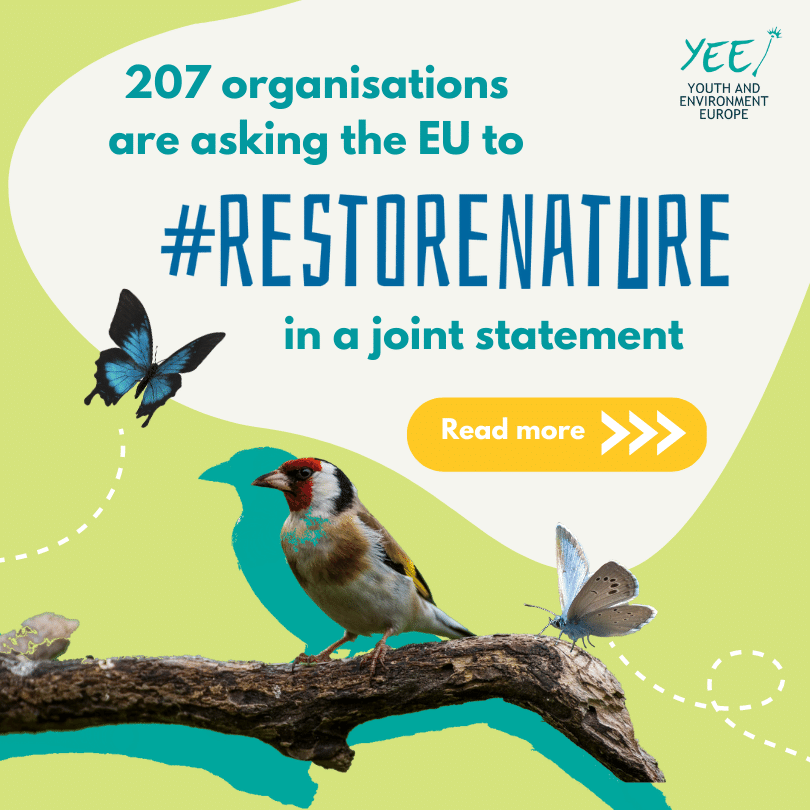
Join us and over 200 NGOs and ask your decision-makers to adopt a solid and urgent implementation of the law that can
Feedback on National Restorations Plans’ format
https://yeenet.eu/wp-content/uploads/2024/02/position.png 250 250 YEE https://yeenet.eu/wp-content/uploads/2018/11/logo-yee-728x1030.png YEE2025-02-07 15:23:032025-02-20 09:43:59Feedback on National Restorations Plans' formatProject assistant
304 hours in total To be distributed unequally*
16.46 EUR per hour (gross)
remote within EUROPE
until October 2025
Start March 2025
Project lead for a short-term assistant on the triple planetary crisis
YEE is seeking a project assistant to support a project lead of a short-term project called Understanding the Triple Planetary Crisis through the Lens of the Right to a Healthy Environment (RtHE).
*This remote position involves an uneven workload from 1st March to 31st October 2025, with the following working periods:
- March-May 2025: 76 total hours (app. 25 per month distributed unevenly with an average remuneration of 411.5 EUR per month);
- August-October 2025: 228 total hours (76 per month distributed unevenly with an average remuneration of 1250.96 EUR per month).
Application deadline: 19th February 2025
Background
The project Understanding the Triple Planetary Crisis through the Lens of the Right to a Healthy Environment (RtHE) addresses the triple planetary crisis—climate change, biodiversity loss, and pollution—focusing on how young people across Europe experience and respond to its varied impacts.
Recognising that these crises transcend borders, the initiative aims to raise awareness, foster solidarity, and empower young people through education, cooperation, and advocacy. By enhancing cross-border knowledge sharing and promoting the right to a healthy environment (RTHE), the project seeks to build a united and strategic youth response to environmental challenges, emphasising the importance of regional and social contexts.
Key objectives include raising awareness of regional differences in experiencing these crises, equipping young people with the skills to advocate for environmental rights, fostering collaboration among youth organisations, and encouraging local and global environmental actions. The project prioritises rural and vulnerable young people across Europe, ensuring inclusivity and diverse representation. Innovative approaches, such as cross-geographical dialogue and visual storytelling, will showcase the role of youth in driving environmental change and strengthen their contributions to a sustainable future.
Responsibilites
The project assistant will support the project lead in carrying out the project activities including:
- Organising a training course for youth workers in Yerevan, Armenia (expected in April/May 2025)
- Developing social media Campaign "Regional perspectives of the RtHE"
- Organising a dialogue in the Symposium comparing the findings of the training course and the academic report conducted by university students. (expected in September 2025)
- Reporting
Candidates we are looking for
- Have experience working on climate change, environmental issues, and local-level advocacy
The ideal profile:
- Has experience in the field of youth work
- Previous experience in project management and/or communications
- Is motivated to interact in an international environment with different organisations, institutions, and individuals
- Is comfortable with being part of a small team
- Has a creative approach and can come up with innovative solutions
- Familiar with non-formal education methodology
Requirements
- Working proficiency in English
- Be able to work remotely and collaborate with the team under this regime
- Be resident in Europe, already with an EU working permit
- Eligible applicants must be younger than 35 years of age
- Be aligned with YEE's core values and mission.
Equal Opportunity
YEE is committed to diversity and inclusion and strongly encourages applications from individuals of all backgrounds, including those from underrepresented groups.
Selection Process
Interested candidates should submit the application form by 19 February 2025 to be considered for the position. Selected candidates will be asked for a remote interview during the week of 24 to 28 February.
For any questions regarding the selection process, contact yee@yeenet.eu.
Call for a project assistant
https://yeenet.eu/wp-content/uploads/2024/02/hiring.png 250 250 YEE https://yeenet.eu/wp-content/uploads/2018/11/logo-yee-728x1030.png YEE2025-02-05 14:25:362025-03-03 09:13:33Call for a project assistant
20 hours/week
1431.8 EUR per month (gross)
remote within EUROPE
until November 2025
Start March 2025
Project lead for a short-term project on the triple planetary crisis
YEE is seeking a project lead for a short-term project called Understanding the Triple Planetary Crisis through the Lens of the Right to a Healthy Environment (RtHE).
This position is remote and requires an average of 20 hours per week of work until November 30th, 2025.
Application deadline: 19th February 2025
Background
The project Understanding the Triple Planetary Crisis through the Lens of the Right to a Healthy Environment (RtHE) addresses the triple planetary crisis—climate change, biodiversity loss, and pollution—focusing on how young people across Europe experience and respond to its varied impacts.
Recognising that these crises transcend borders, the initiative aims to raise awareness, foster solidarity, and empower young people through education, cooperation, and advocacy. By enhancing cross-border knowledge sharing and promoting the right to a healthy environment (RTHE), the project seeks to build a united and strategic youth response to environmental challenges, emphasising the importance of regional and social contexts.
Key objectives include raising awareness of regional differences in experiencing these crises, equipping young people with the skills to advocate for environmental rights, fostering collaboration among youth organisations, and encouraging local and global environmental actions. The project prioritises rural and vulnerable young people across Europe, ensuring inclusivity and diverse representation. Innovative approaches, such as cross-geographical dialogue and visual storytelling, will showcase the role of youth in driving environmental change and strengthen their contributions to a sustainable future.
Responsibilites
The project lead will be responsible for carrying out all the project activities including:
- Attending and contributing to a preparatory meeting in March 2025
- Organising a training course for youth workers in Yerevan, Armenia (expected in April/May 2025)
- Developing social media Campaign "Regional perspectives of the RtHE"
- Organising a dialogue in the Symposium comparing the findings of the training course and the academic report conducted by university students. (expected in September 2025)
- Reporting
Candidates we are looking for
- Has previous experience in project management and communications
- Has acquired knowledge on the Right to a Healthy Environment
- Has experience working on climate change, environmental issues, and local-level advocacy
- Have experience and a good understanding of stakeholder’s engagement.
- Undertakes responsibilities and carries out tasks independently whilst being a good communicator
- Familiar with non-formal education methodology
The ideal profile:
- Has experience working with the European Youth Foundation or the Council of Europe
- Has experience in the field of youth and environmental advocacy
- Is motivated to interact in an international environment with different organisations, institutions, and individuals
- Is comfortable with being part of a small team
- Has a creative approach and can come up with innovative solutions
- Has an experience as a trainer in non-formal education
Requirements
- Working proficiency in English
- Be able to work remotely and collaborate with the team under this regime
- Be resident in Europe, already with an EU working permit
- Eligible applicants must be younger than 35 years of age
- Be aligned with YEE's core values and mission.
Equal Opportunity
YEE is committed to diversity and inclusion and strongly encourages applications from individuals of all backgrounds, including those from underrepresented groups.
Selection Process
Interested candidates should submit the application form by 19 February 2025 to be considered for the position. Selected candidates will be asked for a remote interview during the week of 24 to 28 February.
For any questions regarding the selection process, contact yee@yeenet.eu.
Call for a part-time project lead
https://yeenet.eu/wp-content/uploads/2024/02/hiring.png 250 250 YEE https://yeenet.eu/wp-content/uploads/2018/11/logo-yee-728x1030.png YEE2025-02-05 12:18:262025-07-23 15:31:50Call for a part-time project lead
short-term contract
€1,775 – 2,150 in total (gross)
remote within EUROPE
until May 2025
Start March 2025
Intersectionality expert with with experience in non-formal education
YEE is seeking an expert who can bring depth to the training by addressing specific challenges faced by marginalised communities, sharing best practices, and fostering meaningful dialogue among participants.
This position requires remote preparation and travelling to Prague to deliver and facilitate the training in April 2025.
Application deadline: 16th February 2025
Background
Empowering the Unheard is a Youth and Environment Europe (YEE) project centred on intersectionality with a core mission to support young individuals with fewer opportunities in their entry into the climate movement.
Over the past year, the project has supported 10 initiatives across Europe, engaging marginalised and vulnerable communities in environmental actions. As the project nears its conclusion, we are organising a 5-day training to bring together project participants. This training will create a space for sharing regional experiences, exchanging expertise, and building participants’ capacities to continue working with marginalized youth in their communities.
Responsibilites
- Develop a plan for the study session together with the Project Lead
- Attend at least 2 preliminary online meetings with the Project Lead for the preparation of the training
- Support the facilitation of interactive sessions using non-formal education methods for a group of 20-25 participants (3 full days of training plus arrival and departure days with limited activities)
- Conduct at least 2 learning activities within the training specifically focusing on topics affecting marginalised and vulnerable youth
- Support the development of the handbook based on the findings and insights of the training (contribute to the writing and/or editing of the handbook’s content)
Candidates we are looking for
- With expertise in intersectionality, inclusion, and environmental justice through academic studies and/or professional experience;
- With proven experience working with marginalized and/or vulnerable groups (e.g. minorities, people with disabilities, LGBTQIA+ youth, or others) in an educational or advocacy capacity;
- With at least 1 year of experience designing and delivering youth trainings using non-formal education methods;
- With availability for the specific dates of the training during calendar weeks 15–16 (mid April)
The ideal profile:
- Has understanding of the climate crisis and intersectionality nexus on an academic and/or professional level
- Has personal experience in activism or community engagement.
Requirements
- Working proficiency in English
- Be able to work remotely and collaborate with the team under this regime
- Be resident in Europe, already with an EU working permit
- Eligible applicants must be younger than 35 years of age
- Be aligned with YEE's core values and mission.
Compensation:
This is a paid position with a fixed compensation range 1,775 – 2,150€. The final amount will be determined based on the selected candidate’s level of experience and the specific extent of their contributions to the training and handbook development.
Payment will be issued upon invoice submission.
Equal Opportunity
YEE is committed to diversity and inclusion and strongly encourages applications from individuals of all backgrounds, including those from underrepresented groups.
Selection Process
Interested candidates should submit the application form by 16 February 2025 to be considered for the position. Selected candidates will be asked for an online interview.
For any questions regarding the selection process, contact yee@yeenet.eu.
Call for an intersectionality expert
https://yeenet.eu/wp-content/uploads/2024/02/hiring.png 250 250 YEE https://yeenet.eu/wp-content/uploads/2018/11/logo-yee-728x1030.png YEE2025-02-04 17:32:552025-07-23 15:31:51Call for an intersectionality expertReflections on INC-5: A Delayed Milestone, not a Failure
This session was supposed to be the “end of the beginning,” when the world would step out with the first-ever global plastic treaty.
- February 3, 2025
Written by
Shellan Saling
Contents
Explainers
In treaty negotiations, brackets indicate text that is still under discussion and might be added, deleted or revised. They help show areas where agreement has not been found yet. This allows negotiators to know which part of the text needs more debate.
A non-paper is an informal document used in diplomatic negotiations to propose ideas, outline potential solutions, or highlight issues without a formal position.
Share this article
Expectations ran high as delegates convened in Busan, South Korea, from 25 November to 1 December 2024. They met for the fifth session of the Intergovernmental Negotiating Committee (INC) to develop a legally binding instrument on plastic pollution, including in the marine environment.
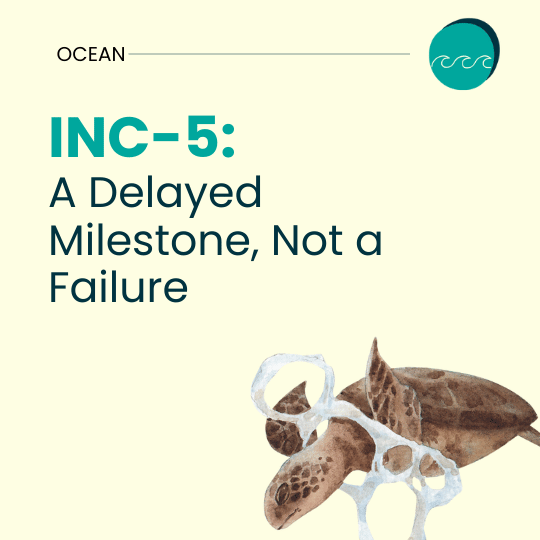
This session was supposed to be the “end of the beginning,” when the world would step out with the first-ever global plastic treaty, which did not happen. However, calling INC-5 a failure would overlook the complexities of negotiating and treaty-making and the leap forward that took place at INC-5.
Laying the Foundation for INC-5
The intersessional period between INC-4 and INC-5 was busier than ever, marked by the agreed-upon intersessional work of two working groups. With the revised zero text widely declared unworkable due to the text mostly being bracketed, INC Chair Luis Vayada technically went beyond his mandate with good intention by issuing informal drafts called non-papers which aimed to bring member states to an agreement. The final one, non-paper three, outlined a treaty with proposed ways forward to INC-5 and COP-1. As a result, there was a lot of uncertainty over which paper would be used as a starting point for negotiations.
Familiarity with the past at the beginning of INC-5
As the plenary opened in Busan, familiar obstacles emerged. Low-ambition countries applied delay tactics, resurrecting the ever-prolonged debate over the still-in-draft form rules of procedure. Hours of discussion yielded few breakthroughs, but eventually, the chair and most member states agreed to continue with the draft rules of procedures, meaning all decisions would still require consensus. There was also a debate about whether negotiations should start from the revised zero draft or non-paper three. The consensus ruled in favour of starting at non-paper three as the negotiating text with the caveat the Member States could propose additional text. This allowed delegates to break into contact groups earlier than in previous sessions, a small but important step to keep discussions focused on substantive issues. Two new drafts of the treaty (non-papers) were produced throughout INC-5 with an agreement to resume session 5 with the “Chair’s Text” agreed by member states.
From an outsider’s perspective, the negotiations may have appeared to spin in circles. This was further reinforced by major news reporting INC-5 as a failure with headlines such as, “U.N. treaty talks collapse”, “Countries fail to reach agreement in the UN plastic talks”, or “Negotiators fail to reach an agreement on a plastic pollution treaty”, painting a picture of deadlock and disappointment. Such characterisations, however, miss a critical nuance: incremental progress often defines the rhythm of international treaties. Expectations to finalise the first-ever global plastic treaty within two and a half years of UNEA Resolution 5/14 at UNEA 5.2 in March 2022 were always ambitious, as they should be to address the urgency of this crisis. Naturally, there was disappointment. Many people who had been working on this process for a long time knew in the back of their minds that INC-5 was going to be a steep uphill battle to finalise a treaty and that additional INCs were likely.
Despite these challenges, INC-5 marked a subtle, yet significant turning point. For the first time, we saw a clear majority emerge with more than 100+ countries uniting in wanting a treaty that addresses the full lifecycle of plastics that includes production limits. This is in addition to many stakeholders and observers including youth, children, scientists, businesses, indigenous, frontline communities and rights holders having voiced this from the very beginning of negotiations, if not long before the treaty negotiations began. This emerging consensus on reduction-oriented measures contrasts sharply with the minority of member states wanting strictly a waste-management treaty, an approach that has been long favoured and known by less ambitious member states and industry stakeholders. Had negotiators settled for a weaker, waste management-focused deal in Busan, the world might have walked away with a quick agreement, but at the cost of ignoring scientists and jeopardising lasting solutions to protect vulnerable groups from the impacts of plastic pollution. Growing voices argue that no treaty is better than a weak one.
Lessons from History
It is critical to look at these negotiations in the history of multilateral environmental agreements (MEAs). Building on decades of advocacy and awareness around plastic pollution, these negotiations are moving at a pace that reflects both urgency and complexity. While addressing the plastic crisis with this treaty is extremely urgent with current predictions seeing plastic production triple by 2060 without intervention negotiations are still going at a swift pace compared to other MEAs. Notably, the Paris Agreement took 6 years to negotiate, building from the momentum of decades of climate talks. The most recent High Seas Treaty, finalised in 2023, took nearly two decades of discussions and five years of formal negotiations. Countless other MEAs have taken more than two years to be negotiated. Even though the plastic treaty negotiations are being extended to 2025, if countries can agree, it would remain one of the fastest global environmental agreements ever forged. Based on INC-5 and the unity that has converged it is possible for countries to agree by the end of 2025, if not sooner.
Challenges and looking ahead
Negotiations are still expected to overcome plenty of challenges before reaching a conclusion. Observers were locked out for nearly half of the negotiations and must be included in all negotiations going forward. Youth delegates (35 and younger) continue to lack power and decision-making authority over their own future. Whether part of government delegations or observers, young people and future generations are set to be the most impacted by the plastic crisis. Some of the most contentious sections of the treaty include those addressing hazardous chemicals in plastics (Article 3), sustainable production (Article 6), and funding mechanisms (Article 11)., yet are some of the most important articles in the treaty. They must be ambitious with bold targets and robust funding mechanisms. Ultimately, this treaty will have a significant impact on our generation and those to come. It is up to us to decide how we want to change history.
While we await when and where session 5 will reconvene, it is evident the debate is no longer confined to the technicalities. It is a fundamental question of whether the treaty will embrace meaningful reductions in plastic production, supply, and demand and provide strong protection for vulnerable communities and ecosystems. Resisting compromise on ambitious goals and ensuring active engagement from all stakeholders, including youth, will determine the treaty’s trajectory. History suggests it will take time, and INC-5, far from failure, may be remembered as another critical stepping stone toward a strong, science-based, ambitious global plastics treaty.
There are still many unresolved questions and concerns, including procedural matters and the critical issue of determining which document will serve as the basis for negotiations in section 5.2. Options include using the Chair’s text, combining different drafts, or allowing countries to make further changes to the text. A final critical question remaining from INC-5: Is multilateralism the right path forward for this treaty? While consensus has been foundational for treaty-making, the urgency of addressing the plastic crisis is a reason to look at alternative approaches such as voting on unresolved issues. Although untraditional in the treaty-making process, it could speed up the progress towards reaching an agreement.
The path forward requires bold and daring action to keep up the momentum by reconvening as soon as possible for session 5.2 because our generation and those to come are on the line if we do not get an ambitious treaty as soon as possible.
More articles about marine pollution
Reflections on INC-5: A Delayed Milestone, not a Failure
https://yeenet.eu/wp-content/uploads/2025/02/INC5.png 540 540 YEE https://yeenet.eu/wp-content/uploads/2018/11/logo-yee-728x1030.png YEE2025-02-03 09:40:182025-02-03 13:15:04Reflections on INC-5: A Delayed Milestone, not a FailureOur mission
YEE aims to unite environmental youth non-profit organisations in Europe in order to enhance international cooperation, increase knowledge about the climate crisis, raise awareness of environmental problems and to strengthen participation of youth in environmental decision-making.
Get in touch
Vinohradská 2165/48
120 00 Praha 2 – Vinohrady
Czech Republic
E-mail: yee@yeenet.eu


Financially supported by the European Youth Foundation of the Council of Europe. The views expressed do not necessarily reflect the official position of the Council of Europe.