Pushing for accountability: Youth voices at the Aarhus Convention
YEE's experience advocating for youth in Geneva
- July 18, 2026
Written by
Olatz Bulson-Roman
Contents
Share this article
In the final week of June, the 30th meeting of the Working Group of the Parties to the Aarhus Convention was held at the United Nations in Geneva. Conversations and negotiations in the corridors of the Palais were cut short as the mounting heat became increasingly stifling. Against the backdrop of a sweltering heatwave, the meeting room became a cool refuge. For many of the NGOs and civil society representatives in the Aarhus ECO Forum, the temperature added an undeniable urgency and frustration to discussions which still seemed to lack ambitious commitment.
YEE and the Compliance Committee
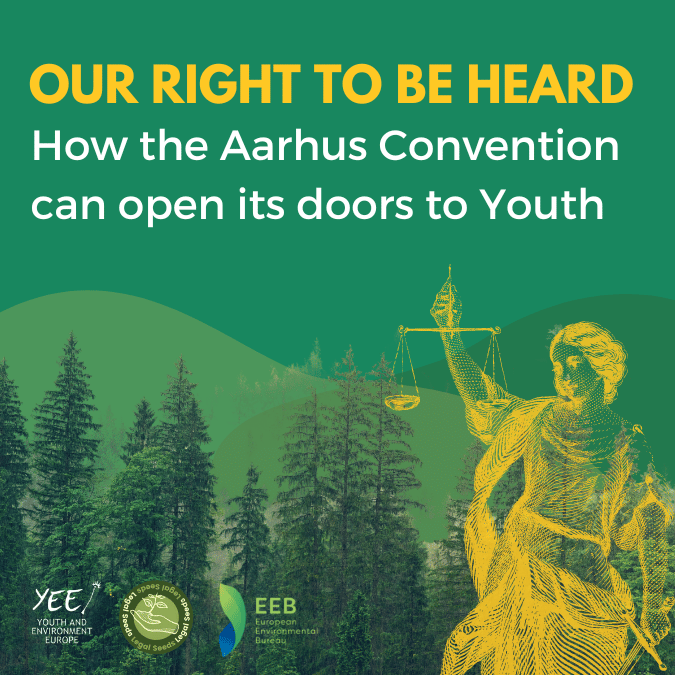
As the only youth observer to the Aarhus Convention, Youth and Environment Europe (YEE) intervened on topics throughout discussions to ensure that youth perspectives were accounted for during the meeting. For example, we took the floor to highlight youth experiences engaging with the Compliance Committee, the treaty’s independent body that reviews public complaints on environmental rights, and to express concerns on the funding crisis of the convention as well as intergenerational fairness. While a contact group has been set up as a result of this meeting, faced with a piling workload and reduced staff capacity, the invaluable work of the Compliance Committee is undermined if parties continue not to fulfil their financial commitments.
Added to this, a survey to compile experiences of those engaging with the Compliance Committee is going to be published. Over the days, it became clear that parties (namely the UK and the EU and its member states) were pushing for the outcomes of this unwritten survey to have the power to revisit Meeting of the Parties’ decisions and revise core mechanism documents. This is a worrying move as it raises questions as to the intentions behind these powers, which can be easily co-opted and undermine the democratic principles underlying the convention.
Raising environmental defenders’ voices
Despite these concerns, there were nonetheless hopeful breakthroughs during the week. For example, the intervention of YEE representative Xabier Gomez raised the challenges and insights gathered from the first-ever Environmental Human Rights Defenders (EHRD) Forum in Strasbourg, which took place at the beginning of June this year. By amplifying the testimonies of youth defenders and reiterating the need for the explicit protection of young environmental defenders, parties agreed to recognise the importance of ensuring the safety of environmental defenders for effective implementation of the Convention in the outcomes of the meeting.
Consolidating support for the Right to a Healthy Environment
The Campaign for the right to a clean, healthy and sustainable environment in the Council of Europe is also continuing to build momentum. Gathering outside the Palais des Nations, a lunchtime protest reminded the 46 Council of Europe member States that we still demand political leadership to start negotiations on a binding treaty. States were invited to a roundtable breakfast where representatives from countries, institutions and civil society were able to bring questions and share ideas on the Campaign. At this event, we were able to brief States on youth perspectives taken from the EHRD Forum in Strasbourg to demonstrate how the Right to a Healthy Environment underpins the enjoyment of all other human rights. From these conversations, it is clear that we are at a hopeful tipping point to progressing this topic within the Council of Europe, momentum which provided a glimmer of hope across an otherwise sobering week.
Civil society, institutions and all other parties to the Convention must continue to advance Aarhus rights: the right to environmental information, the right to public participation and the right to access justice in environmental governance. It is of utter importance, especially during this intersessional period, if we are to safeguard our right to a clean, healthy and sustainable environment.
More articles about Environmental Defenders
Pushing for accountability: Youth voices at the Aarhus Convention
https://yeenet.eu/wp-content/uploads/2023/11/law-light.png 500 500 Erica Gentili https://yeenet.eu/wp-content/uploads/2018/11/logo-yee-728x1030.png Erica Gentili2026-07-18 17:48:322026-07-18 18:01:05Pushing for accountability: Youth voices at the Aarhus ConventionDesigning Climate Action That Works
Four cases from the Y-RESCUE project
- July 18, 2026
Contents
Want to know more about the Youth for Resilient Cities and Urban Environments project? Check out the Y-Rescue dedicated page!
Share this article
This report outlines the cultural relevance of the four Y-RESCUE challenge cases and presents our key insights and recommendations for future work packages. We evaluated these cases to ensure they are inclusive, highly adaptable, and meaningful across diverse European cities.
Adapting to the local scene
The assessment combined four evidence sources: a desk-based knowledge review, 21 stakeholder interviews, over 300 youth surveys, and a focus group workshop with 16 experts and stakeholders.
Together, these informed the development of challenge cases that reflect shared urban climate issues across Europe, including air pollution, extreme heat, lack of green space, underused urban land, food insecurity, and unequal exposure to environmental risks. The process focused on creating challenge frameworks that are flexible enough to work across different governance systems, climate zones, municipal capacities, and neighbourhood contexts.
Making it matter for Youth
The assessment also examined how well the cases align with youth priorities, participation realities, and cultural inclusion. Findings showed that young people are most motivated by climate action that is practical, community-based, visible, creative, and meaningful rather than symbolic.
To reduce exclusion, the cases avoid assumptions about digital access, technical expertise, free time, institutional trust, or identical experiences across countries.
Particular attention was given to vulnerable groups such as low-income communities, migrants, older adults, children, and people with disabilities.
Overall, the assessment confirmed that the four cases address urgent urban climate challenges while supporting equitable participation, youth leadership, local innovation, and practical action adaptable to many European contexts.
What is Y-Rescue?
Y-RESCUE is a project that empowers young people to lead transformative climate action in urban areas increasingly threatened by environmental challenges. Launched in 2025, the project is mobilising 300 young participants (aged 18–30) and youth organisations across several European partner countries to co-create local resilience solutions and strengthen youth entrepreneurship in the climate field. More specifically, throughout Y-RESCUE, partners and young participants together attend workshops, identify challenges, and come up with innovative solutions. By making the most of peer learning, mentorship, and shared resources, the project will build its participants’ skills in leadership and project management, while ensuring valuable action is carried out to fight environmental challenges.
More articles about climate action and resiliance
-
Feature Item 1
-
Feature Item 1
Designing Climate Action That Works
https://yeenet.eu/wp-content/uploads/2026/07/Screenshot-2026-07-18-165338.png 724 801 Erica Gentili https://yeenet.eu/wp-content/uploads/2018/11/logo-yee-728x1030.png Erica Gentili2026-07-18 16:51:092026-07-18 16:54:15Designing Climate Action That WorksDefending the Environmental Defenders
Key takeaways from the first-ever forum for Environmental Human Rights Defenders
- July 17, 2026
Written by
Olatz Bulson-Roman
Contents
Share this article
Claire Leduc
On the 3rd and 4th June 2026, the Council of Europe hosted the first-ever Forum for Environmental Human Rights Defenders (EHRDs) in Strasbourg, France. More than 280 defenders from across Europe came together alongside NGOs, EU institutions, and state representatives to exchange experiences, strengthen connections, and advance environmental rights.
As one of the forum’s co-organisers, Youth and Environment Europe (YEE) attended and supported several sessions and initiatives throughout the event. This included the establishment of a Youth Taskforce, bringing together youth representatives from civil society organisations, UN and EU institutions to support the active participation of youth EHRDs and ensure that their perspectives were visible and reflected in discussions.
YEE’s contribution to the Forum and support to young EHRDs
The ability to bring, for example, youth EHRDs together is critical to empowering defenders. It is through gathering that defenders are better able to share ideas, advocacy and testimonies. This coming-together is essential to creating vital solidarities in the face of the ongoing persecution of EHRDs.
It is an opportunity for those actively risking their own wellbeing to safeguard our shared Environmental Human Rights and futures to have their voices and stories not only heard, but also amplified and acted on.
Within the organisational structure of the Forum, YEE were proud to be working within the Youth Task Force sub-committee. We aimed to promote and safeguard youth engagement throughout the event.
From ice-breakers and energisers to logistics and raising concerns, we were the port of call for youth EHRDs navigating both the institutional and emotional landscape of the Council of Europe hosting the Forum.
Seeing how youth defenders came together so enthusiastically, empathetically and tirelessly was truly inspiring. Their courage to attend, share their stories and wholeheartedly engage in debates must be met by the momentum to protect all of our shared environmental human rights.
Formalising the right to a healthy environment
A core message which arose from the Forum was the need for a legally binding additional protocol for the Right to a Healthy Environment in the Council of Europe.
Testimonies of repression, persecution and the impacts of undertaking environmental human rights activism on mental and physical health clearly laid out the contemporary hostility for defenders in Europe.
Without this explicit recognition of the right to a clean, healthy and sustainable environment, the critical advocacy of defenders can be dismissed and weaponised due to the lack of a legal instrument which can support both those advocating for our shared future, and thus European rightsholders more generally.
Protection, accountability and democratic action are central to mitigating the environmental and climate crisis. As a result, the Right to a Healthy Environment is a precondition for the enjoyment of all other human rights.
Holding companies accountable for environmental harm
Legal cases holding companies accountable for environmental damage are beginning to emerge across Europe, building good precedents for further legal action. At the same time, while the 2024 EU Environmental Crime Directive has been an important step forward, its transposition across Member States remains slow, demonstrating little appetite to address the issue.
Participants called for greater recognition of, and stronger responses to, corporate harms affecting environmental protection. They also suggested adopting more preventive approaches, such as the active participation of affected communities in Environmental Impact Assessments (EIAs).
Recognising and Protecting Defenders
The recognition of EHRDs and the essential role they play for democracies to be considered healthy was at the core of the discussions. Through organising peaceful protests, acting as watchdogs, and building connections with communities, EHRDs contribute to building a sustainable future.
Across their different contexts, defenders shared concerns about Strategic Litigation Against Public Participation (SLAPPs) and foreign agent laws that continue to restrict civic space. For young people in particular, this often translates into even fewer opportunities to participate in civic life, as limited resources make it harder to respond to legal and administrative pressures.
The 2024 EU Anti-SLAPP directive is a step in the right direction, and should be transposed by Member States widely. Aarhus Convention review mechanisms are also in place to allow for international pressure. In addition, though, participants highlighted that countering this trend requires reclaiming the narrative around environmental activism and increasing the visibility of the contribution that EHRDs make to environmental rights.
A call for action
It is important not to lose the momentum generated by this Forum. This is supported by the legally binding Additional Protocol to the Right to a Healthy Environment in the Council of Europe, as this right is a precondition to enjoy all other human rights. We hope that the testimonies and common advocacy messages shared during the forum will inspire defenders, CSOs, as well as the EU and its Member States to continue building a strong commitment to creating an enabling environment for defenders across Europe. Therefore, as we look ahead, we must continue to defend the defenders who not only safeguard our shared environment, but also our democratic futures.
More articles about Environmental Defenders
Defending the Environmental Defenders
https://yeenet.eu/wp-content/uploads/2023/11/law-light.png 500 500 Erica Gentili https://yeenet.eu/wp-content/uploads/2018/11/logo-yee-728x1030.png Erica Gentili2026-07-17 16:31:322026-08-07 16:33:48Defending the Environmental DefendersOur mission
YEE aims to unite environmental youth non-profit organisations in Europe in order to enhance international cooperation, increase knowledge about the climate crisis, raise awareness of environmental problems and to strengthen participation of youth in environmental decision-making.

Get in touch
Vinohradská 2165/48
120 00 Praha 2 – Vinohrady
Czech Republic
E-mail: yee@yeenet.eu


Financially supported by the European Youth Foundation of the Council of Europe. The views expressed do not necessarily reflect the official position of the Council of Europe.